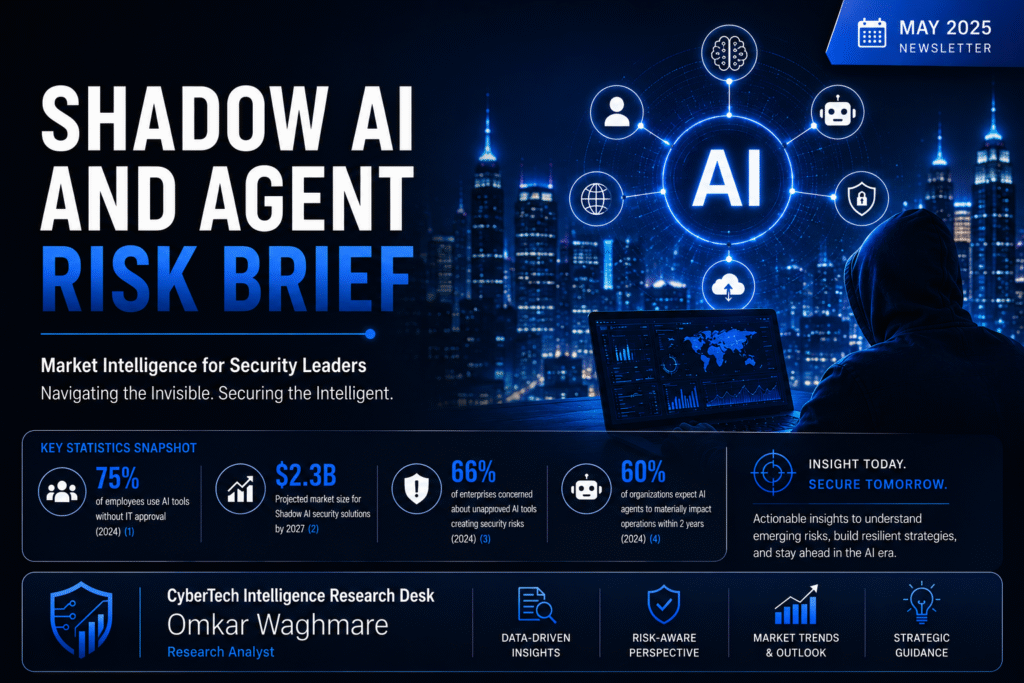
The Invisible AI Crisis Entering Enterprise Networks
The deployment of enterprise AI is already far ahead of the development of governance systems.
What was once a sandbox for employee experimentation with generative AI has escalated at a rapid pace into a far bigger enterprise challenge. Shadow AI and autonomous AI agents operating out of formal oversight.
Employees are deploying AI copilots, browser plug-ins, public LLMs, AI coding helpers, third-party automation services, both within and beyond approved enterprise settings in every industry, creating novel risks for cybersecurity, governance, and operations. (1)
Between 2025 and early 2026, the popularity of this thing skyrocketed among enterprise users, as firms sought to integrate generative AI into their workflows for productivity, customer service, software, and in-house decision-making.
These new systems are also being embedded into increasingly autonomous agentic AI agents that are able to work independently, will be able to act by undertaking actions, accessing apps, kicking off workflows, or executing.
The business opportunity is enormous.
McKinsey projected in 2025 that agentic AI could generate between $2.6 trillion and $4.4 trillion annually across enterprise functions, including customer support, software engineering, compliance automation, supply chain operations, and knowledge management. (2)
But the governance challenge is accelerating just as quickly.
Security leaders are increasingly confronting a difficult reality:
Enterprise AI adoption is occurring faster than enterprise visibility, governance, and security enforcement.
Trend Watch: Shadow AI Moves Into the Boardroom
Shadow AI has mutated into a board-level governance issue.
A 2025 working AI survey showed just how far undisapproved AI use has infiltrated enterprise:
- 86% of employees used AI tools weekly for workplace tasks in 2025 (3)
- 58% used publicly available AI tools instead. The strategy also suggests that the gangs behind ransomware attacks are not merely criminals but adversarial entities threatening the economy d of approved enterprise platforms in 2025 (3)
- 63% believed AI use without IT approval was acceptable in 2025 (3)
- 33% uploaded research or internal datasets into unapproved AI systems in 2025 (3)
- 27% shared employee-related information through external AI tools in 2025 (3)
- 23% exposed financial or sales-related information in 2025 (3)
The driver rarely has malicious intent.
In the most part, employees are just seeking to increase efficiency, automate mundane tasks, speed up research, speed up content creation, or lower friction within operations.
Palo Alto Networks identified in 2025 that adoption of Shadow AI is driven mainly by the employee appetite for rapidity through ChatGPT, AI summarization systems, coding assistants, and browser-based AI integrations. (4)
The concern for enterprise leadership is not whether employees are using AI.
It is whether organizations have visibility into how AI is being used, what enterprise data is being exposed, and which systems autonomous agents are interacting with.
For CISOs, CIOs, and risk leaders, the implication is increasingly clear:
Enterprise AI adoption is now occurring faster than governance enforcement.
Threat Intelligence: The Rise of Shadow Agents
The next phase of enterprise AI risk is emerging through autonomous agents.
Unlike traditional AI systems that simply respond to prompts, agentic AI systems can independently take action.
Modern AI agents increasingly:
- Access enterprise applications
- Trigger workflows
- Generate and deploy code
- Interact with APIs
- Schedule operational tasks
- Communicate with other AI systems
- Exchange enterprise data across platforms
- Operate with limited human intervention
This creates an entirely new enterprise attack surface.
McKinsey identified several risks associated with agentic deployments in 2025, including:
- Chained vulnerabilities
- Cross-agent privilege escalation
- Synthetic identity misuse
- Silent data leakage
- Corruption of downstream decision systems (2)
Google Cloud researchers additionally warned about the emergence of “Shadow Agents” — autonomous systems deployed without centralized governance, visibility, or security controls (5)
This trend is becoming increasingly relevant as organizations integrate AI into SaaS environments, CRM systems, cloud platforms, DevOps pipelines, HR systems, and enterprise automation frameworks.
The concern extends far beyond simple AI misuse.
It now represents a convergence of:
- Insider risk
- Identity compromise
- API exposure
- Automation sprawl
- Governance failure
- Third-party application exposure
Security teams are also becoming increasingly concerned about AI agents inheriting excessive permissions from connected enterprise applications.
An autonomous AI agent connected to collaboration tools, cloud storage, internal APIs, or enterprise productivity suites may unintentionally gain access to sensitive operational context far beyond its intended scope.
This creates the possibility of invisible privilege escalation occurring across interconnected enterprise systems.
The challenge becomes even more complex when organizations begin deploying multiple interacting agents simultaneously.
Agent-to-agent communication, automated workflow chaining, and autonomous decision orchestration are rapidly expanding the enterprise AI attack surface in ways many governance frameworks were never designed to manage.
Visibility Gap: Why CISOs Are Losing Oversight
Conventional cybersecurity architectures were not designed to oversee dialogues with conversational AI or autonomous workflows.
There is also a growing regulatory grip around enterprise AI governance:
- Employee prompts submitted to AI systems
- External dataset uploads
- AI context retention practices
- Cross-agent data exchange
- Third-party AI plug-in behavior
- Autonomous workflow decisions
- AI-generated code deployment activity
The only concern is that it is growing at an almost exponential rate.
In May 2026, Business Insider estimated that one company had hundreds of unsanctioned AI tools for every 1,000 of its employees. (6)
Security executives equate Shadow AI with the SaaS disruption caused several years ago, when employees began using cloud apps more rapidly than new governance structures could respond.
What is different today is the scale and velocity.
Generative AIs can quickly digest, offer knowledge summaries, remember, and disperse enterprise context through interconnected environments.
The architecture of the previous SOC tooling was blind to the concept of prompt-level exposure so much that it simply didn’t exist until about 2 years after it was introduced.
Enterprises also have little to no insight into third-party generative AI integrations built into collaboration tools, browser-based AI extensions, and unauthorized AI APIs.
As AI ecosystems turn more autonomous, companies can lose an ongoing view of the flow of enterprise data between their people, models, agents, APIs, and clouds.
Market Signal: AI Growth Is Outpacing Governance
AI investment momentum continues to accelerate across global enterprises.
Yet governance maturity remains extremely limited.
McKinsey found in 2025 that only 1% of organizations believed their AI adoption had reached maturity despite widespread deployment activity. (2)
This creates a growing imbalance:
High AI adoption
Low governance maturity
Expanding autonomous capability
Limited operational oversight
IBM research continues to show that breaches involving sensitive enterprise information remain among the most expensive operational disruptions organizations face globally. (1)
For regulated industries including banking, healthcare, telecommunications, manufacturing, and government services, unmanaged AI exposure now affects far more than cybersecurity.
It increasingly influences:
- Regulatory compliance
- Intellectual property protection
- Third-party risk management
- Supply chain resilience
- Data residency obligations
- Enterprise AI ethics governance
- Executive accountability
- Board-level operational risk
AI governance is rapidly becoming a business resilience issue rather than solely an IT function.
Regulatory & Governance Momentum
During the years 2025 and 2026, organizations in North America, Europe, and Asia-Pacific stepped up their efforts to formalize an AI governance policy, build risk management controls, and an enterprise oversight system.
Boards and audit committees are increasingly demanding visibility into:
- Enterprise AI usage
- External AI exposure
- Autonomous workflow activity
- AI vendor risk
- Data governance controls
- AI decision accountability
Numerous organizations are now revising their acceptable-use policies for generative AI models, external LLM integrations, and autonomous agents.
The legal and compliance teams are also having to get involved with Enterprise AI deployment decisions because of issues around privacy, exposure of IP, and regulatory responsibility.
This shift is changing the role of the CISO.
Security leaders are no longer responsible only for protecting infrastructure.
They are increasingly expected to govern enterprise AI behavior itself.
Industry Developments: Security Priorities for 2026
Enterprise defenses are evolving toward AI-native governance models.
AI Visibility Platforms
Organizations are investing in platforms capable of identifying unauthorized AI usage, monitoring prompts, detecting leakage risks, and mapping AI interactions across enterprise environments.
Agent Identity Governance
AI agents are increasingly treated as privileged digital identities requiring authentication, authorization, behavioral monitoring, and access governance controls.
Human Oversight
Organizations continue implementing human-in-the-loop governance for high-risk decisions involving finance, healthcare, cybersecurity, and legal operations.
AI Security Testing
Red teaming, adversarial testing, and AI model validation are becoming standard deployment requirements.
Policy Modernization
Standard acceptable-use policies are being redefined to reflect generative AI technology, autonomous agents, and AI-In-Attachment.
Zendesk echoed this point again as late as 2025, noting that using unsanctioned AI was still being ingrained in the culture as a consequence of the pressure to always be productive during work. (8)
The industry message is becoming increasingly consistent:
- Organizations cannot simply block AI.
- They must govern it intelligently
Market Outlook
The enterprise conversation is shifting rapidly.
From:
“How do we implement AI?”
To:
“How do we operate AI securely and at scale?”
Between 2026 and 2028, enterprises are expected to significantly increase investment in:
- AI governance
- AI observability
- Agent monitoring
- AI access management
- Autonomous workflow oversight
- AI security analytics
Organizations establishing governance and visibility early are likely to gain advantages in:
- Operational resilience
- Regulatory readiness
- Enterprise trust
- Secure automation maturity
- Long-term scalability
Organizations that fail to govern AI exposure may face increasing risks tied to:
- Data leakage
- Non-compliance
- Brand damage
- Automation instability
- Uncontrolled AI sprawl
- Third-party exposure
The next generation of enterprise operations will rely heavily on AI-driven automation.
The competitive differentiator will increasingly be how securely that AI ecosystem is governed.
Executive Takeaways
- Shadow AI is now an active enterprise security challenge
- Unauthorized AI adoption accelerated significantly during 2025 (3)
- Agentic AI introduces autonomous operational and cybersecurity risk
- AI agents are rapidly expanding enterprise attack surfaces
- McKinsey projected in 2025 that $2.6T–$4.4T in annual AI value is accelerating deployment pressure (2)
- Only 1% of organizations reported mature AI adoption in 2025 (2)
- AI visibility, agent identity governance, and monitoring are becoming core 2026 enterprise security priorities
- Human oversight remains essential for high-risk autonomous AI operations
References
- IBM Think. 2025. Shadow AI Overview. IBM.
- McKinsey & Company. 2025. Deploying Agentic AI with Safety and Security: A Playbook for Technology Leaders. McKinsey & Company.
- EY. 2025. EY 2025 Work Reimagined Survey. EY
- BlackFog.
- Palo Alto Networks. 2025. What Is Shadow AI? Palo Alto Networks.
- Google Cloud Community. 2025. Shadow Agents: Enterprise AI Risk. Google Cloud Community.
- Business Insider. 2026. Sneaky Rise of Shadow AI in the Workplace. Business Insider, May 2026.
- Zendesk. 2025. Shadow AI and Workplace Productivity. Zendesk.
🔒 Login or Register to continue reading