
There’s a lot of excitement around AI in security right now, and for good reason. It promises faster analysis, better signal detection, and reduced manual effort.
However, in practice, most teams are still figuring out how to use it meaningfully.
Attackers, on the other hand, don’t have the same constraints.
They are using AI in very practical ways. Automating reconnaissance. Testing variations of attacks. Refining phishing attempts until they work. None of this is particularly flashy, but it is effective.
The gap shows up in how quickly each side can adapt.
The Risk No One Tracks: AI Adoption Without Oversight
Defenders are integrating AI into workflows. Attackers are using it to accelerate workflows.
There’s also a second layer to this that doesn’t get talked about enough. AI is being adopted internally without much friction. Teams are pasting data into tools, experimenting with models, and building small automations. Useful, yes. Controlled, not always.
That creates exposure in places most security teams aren’t actively monitoring yet.
AI is not just a capability you add to your stack.
It quietly becomes part of your environment, and anything that becomes part of your environment becomes something that needs to be secured.
Insights from Google’s Cybersecurity Forecast 2026 reinforce the same pattern. Threat actors are no longer experimenting with AI. They are operationalizing it across the entire attack lifecycle, using it to increase the speed, scale, and effectiveness of attacks.
At the same time, defenders are adopting AI to enhance detection and response, creating what is effectively an arms race between offensive and defensive capabilities
Identity Is Where Most Breaches Begin
There’s a tendency to think of breaches as something dramatic. An exploit. A vulnerability, or a piece of malware.
IBM’s Cost of a Data Breach Report 2024 found that stolen or compromised credentials were the most common initial attack vector, responsible for 16% of breaches globally, and among the costliest, averaging $4.81M per incident.
Valid credentials are often obtained through phishing, reuse, or simple oversight, giving attackers exactly what they need.
From there, they don’t have to break anything. They just have to move carefully enough to avoid attention.
What makes this difficult is that nothing initially looks wrong. The access is legitimate. The systems are behaving as expected.
By the time something feels off, the attacker is already well inside the environment.
This is where a lot of traditional thinking breaks down. Security models that focus heavily on keeping threats out struggle when the threat looks like a normal user.
Identity is the path of least resistance. In most environments, it is still not being monitored with the depth it requires.
Speed Has Become the Deciding Factor
One of the more subtle changes in recent years is how quickly attacks progress.
It is no longer unusual for an attacker to move from initial access to lateral movement in a very short window. What used to take hours can now happen fast enough that by the time an alert is reviewed, the situation has already escalated.
This creates a kind of pressure that many teams feel but don’t always articulate.
Processes that rely on escalation, validation, or multiple handoffs start to break down under that pressure. Not because they are poorly designed, but because they were built for a different pace.
The natural response is to add more automation, which helps. But automation without context can create its own problems. Acting faster only works if you are acting on the right signals.
According to CrowdStrike, the average breakout time, the time it takes an attacker to move laterally after initial access, has dropped to around 29 minutes, with some cases occurring in under a minute.
The real challenge is not just speed. It is fast and right at the same time.
Malware-Free Activity Is Harder to Spot Than It Seems
There’s been a lot of discussion around malware-free attacks, but the reality of what that looks like day-to-day is easy to underestimate.
It doesn’t feel like an attack, but like someone using the system.
Built-in tools get used. Scripts that already exist get repurposed. Access that was already granted gets extended slightly further than it should.
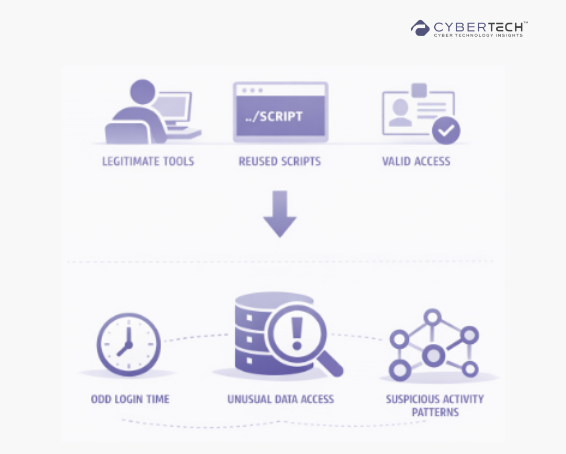
Individually, none of these actions stand out. Together, they form a pattern.
The difficulty is that most environments were not designed to detect patterns. They were designed to detect anomalies that look clearly wrong.
Now the signals are softer.
A login at a slightly unusual time. Access to a dataset that is technically allowed, but contextually odd. A sequence of actions that doesn’t quite fit.
Catching that requires a different level of attention. Less reliance on predefined rules, more emphasis on understanding behavior over time.
Fragmentation Is Making Everything Harder Than It Needs to Be
If you look at most security stacks today, they make sense in isolation.
Each tool solves a specific problem. Endpoint protection. Identity management. Cloud security. Logging. Monitoring.
The issue is not capability. It is coordination.
Attackers move across these layers without thinking about boundaries. They don’t see separate systems. They see one environment.
Defenders, on the other hand, often have to piece things together after the fact. A signal here, another there, each one incomplete on its own.
This slows everything down.
It also creates situations where the full story is never entirely clear, which makes confident decision-making difficult.
There’s a growing realization that more tools don’t necessarily mean better outcomes.
At some point, the focus has to shift to how well those tools work together, and whether they actually reflect how the environment operates in reality.
Trust Is Doing More Harm Than Most Teams Realize
One of the more uncomfortable truths in modern cybersecurity is this.
A lot of systems work on the assumption that once something is trusted, it can continue to be trusted.
That assumption no longer holds.
Access is granted, and then rarely revisited. Integrations are approved and then left as they are. Users accumulate permissions over time, often without a clear reason.
Each of these decisions makes sense in the moment. Together, they create a network of implicit trust that is difficult to track and even harder to challenge.
Attackers understand this.
They don’t need to break trust. They just need to find where it already exists and use it.
This is why the conversation around zero trust has gained traction, even if the implementation is still uneven.
At its core, it is less about a framework and more about a mindset. Trust should not be permanent. It should be continuously evaluated.
Conclusion
What’s happening in cybersecurity right now is not just a shift in threats. It’s a shift in how those threats fit into everyday operations.
Attackers are no longer operating in ways that clearly stand out. They are working within the same systems, using the same access, and moving in ways that feel routine.
That makes the problem harder, not because it is more complex, but because it is less obvious.
For security leaders, this changes where the focus needs to be.
It is no longer about having more data or more tools. Most teams already have plenty of both. The real challenge is figuring out what deserves attention and acting on it without hesitation.
That’s not a tooling problem. It’s a thinking problem.
The organizations that are starting to get this right are not necessarily the ones with the biggest budgets or the most advanced stacks. They are the ones who have stepped back and simplified. They understand how their environments actually behave and where the real risks sit.
FAQs
1. How is AI changing the cybersecurity threat landscape in 2026?
AI is accelerating both sides of cybersecurity. Attackers are using it to automate reconnaissance, refine phishing, and scale attacks faster, while defenders are still integrating it into workflows. The result is an imbalance where threats evolve faster than most security operations can respond.
2. Why are identity-based attacks increasing across enterprises?
Attackers are shifting from breaking into systems to logging in using valid credentials. Stolen or reused identities allow them to bypass traditional defenses and operate undetected. As a result, identity has become the primary attack surface in modern environments.
3. What is “breakout time” and why does it matter to security leaders?
Breakout time refers to how quickly an attacker moves laterally after gaining initial access. Today, it can happen in under an hour, sometimes minutes, leaving very little room for response. This makes speed and early detection critical to preventing full-scale compromise.
4. Why are malware-free attacks harder to detect?
Malware-free attacks use legitimate tools, scripts, and access already present in the environment. Because the activity appears normal, traditional detection methods often miss it. The real challenge is identifying subtle behavioral patterns rather than obvious threats.
5. Why is having more cybersecurity tools not improving security outcomes?
Most organizations have strong tools but operate them in silos. This fragmentation limits visibility across attack paths and slows response. The issue is not lack of capability, but lack of coordination and clarity in how signals are connected and acted upon.
To participate in upcoming interviews, please reach out to our CyberTech Media Room at info@intentamplify.com.