The launch of the Threat Research Center by Atos is not just a capability expansion. It is a structural signal of where cybersecurity is heading.
According to the official announcement, the TRC is designed to deliver earlier, deeper, and more actionable threat intelligence, with direct integration into security operations to accelerate response and reduce exposure windows.
The Shift from Visibility to Response Velocity
Broader industry reality reflected in research from Microsoft, CrowdStrike, and Google Cloud:
Cyber risk is no longer defined by visibility gaps. It is defined by response latency.
- Microsoft highlights AI-driven attack acceleration across the lifecycle.
- Google Cloud threat intelligence shows automated, large-scale attack orchestration.
Security architectures built for delayed response are no longer viable.
The Structural Gap: Intelligence Exists, Action Does Not
Across intelligence reporting from SANS Institute, GreyNoise, and Team Cymru, a consistent pattern emerges:
- Internet-wide scanning begins within minutes.
- Exploitation often occurs within hours.
- Attackers operate through automated, continuous workflows.
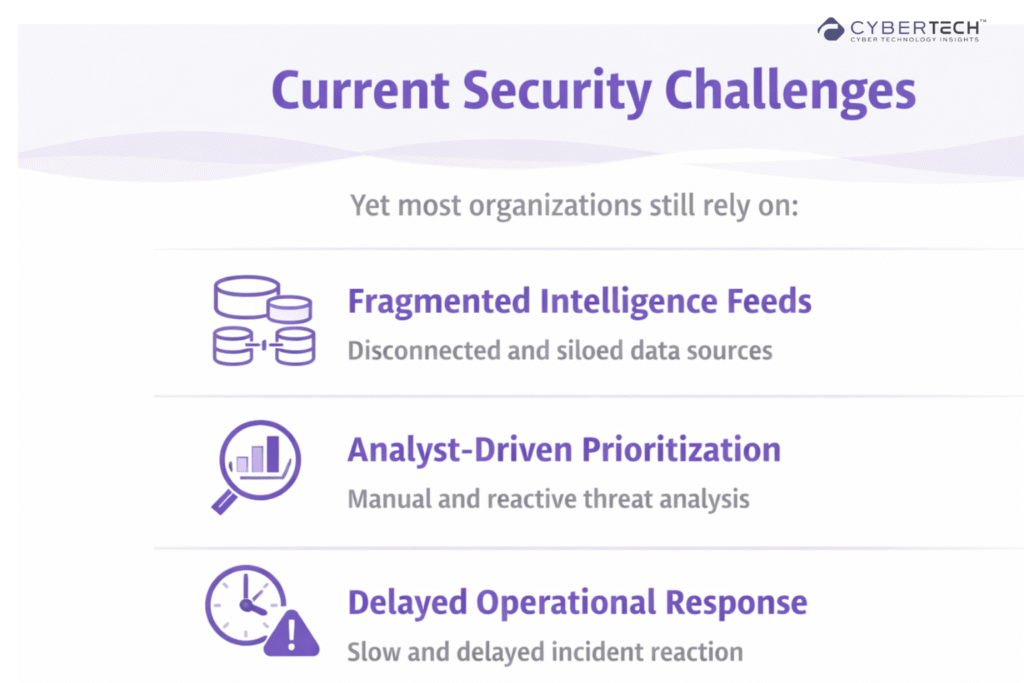
This creates a measurable gap. Intelligence is available. Execution is delayed.
The Atos TRC (Threat Research Center) is designed to close this gap by embedding intelligence directly into operational workflows.

What Atos Is Building: Intelligence as an Operational System
Image by pikisuperstar on Freepik
The Atos TRC moves beyond aggregation toward operational intelligence.
Core Capabilities (Atos TRC)
- Real-time threat intelligence ingestion and correlation.
- Integration into Threat Detection, Investigation, and Response (TDIR).
- Cross-domain intelligence (IT, OT, cloud, network).
- AI-supported prioritization and early vulnerability detection.
According to Atos, the objective is to:
Reduce exposure windows and enable proactive remediation through intelligence-led operations.
Industry Data Signals: Why This Model Is Necessary
Attack Speed vs Defense Speed
| Metric | Industry Finding | Source |
| Breakout Time | 29 minutes | CrowdStrike Global Threat Report |
| Exploit Timing | Within hours of disclosure | CISA / CSO Online (Langflow case) |
| Scanning Activity | Begins within minutes | GreyNoise telemetry |
| AI Attack Growth | Rapid increase in AI-assisted attacks | Microsoft Threat Intelligence |
These signals reinforce a critical shift: The window between exposure and impact is now operationally negligible.
Vendor Intelligence Benchmarking
| Capability | Atos TRC | Microsoft | CrowdStrike | Google Cloud |
| Intelligence Model | Centralized correlation hub | Distributed telemetry | Adversary-centric intelligence | AI-driven analytics |
| Core Strength | Unified intelligence + automation | Identity + cloud telemetry | Threat actor tracking | Infrastructure-scale visibility |
| Speed Focus | Real-time prioritization | Identity-based detection | Breakout time reduction | Automated anomaly detection |
| Intelligence Scope | IT + OT + multi-domain | Enterprise + cloud | Endpoint + adversary intel | Cloud + infrastructure |
| Strategic Gap | Ecosystem scale | Edge visibility | Supply chain intelligence | Multi-cloud complexity |
Where Microsoft and CrowdStrike dominate in telemetry and adversary intelligence, Atos is differentiating through:
Unified correlation and operational integration.
Framework: The Intelligence-to-Action Model
Traditional Model vs Emerging Model
| Layer | Traditional Security | Intelligence-Led Security |
| Intelligence | Passive, feed-based | Real-time, contextual |
| Detection | Alert-driven | Intelligence-prioritized |
| Response | Manual / delayed | Automated / immediate |
| Outcome | Reactive containment | Proactive prevention |
This aligns with evolving frameworks such as:
- Continuous Threat Exposure Management (CTEM).
- Intelligence-driven SOC models.
- Zero Trust operationalization.
Strategic Implications for Security Leaders
1. Intelligence Must Be Embedded, Not Accessed
Threat intelligence must directly inform:
- SOC workflows.
- Incident response.
- Risk prioritization.
2. Speed Becomes a Core Security Metric
Security effectiveness is now measured by:
- Time to detect.
- Time to respond.
- Time to contain.
3. Centralization Enables Decision Velocity
Fragmentation slows execution.
Centralized intelligence enables:
- Faster correlation.
- Better prioritization.
- Coordinated response.

Conclusion: Intelligence as the Control Layer
What Atos is signaling with the Threat Research Center is not an incremental evolution. It is a shift in how cybersecurity must operate.
The TRC is designed to reduce exposure windows, accelerate response, and embed intelligence directly into operational decision-making.
This reflects a broader industry reality. Security architectures built on delayed response can no longer keep pace with automated, high-speed attacks.
As attack execution becomes continuous, the only sustainable control mechanism is intelligence that operates at the same speed.
This is the real significance of the Atos move.
A transition toward intelligence as the operational control layer.
In today’s threat landscape, advantage is no longer defined by what you can see. It is defined by how fast you can act on it.
FAQs
1. What is the biggest challenge in modern cybersecurity operations?
The biggest challenge is not lack of visibility, but slow response. Modern attacks execute within minutes or hours, while many security operations still rely on delayed detection and manual response workflows.
2. Why is response speed critical in today’s threat landscape?
Attack timelines have compressed significantly, with scanning starting within minutes and exploitation often occurring within hours. Faster response directly reduces breach impact and exposure windows.
3. How does threat intelligence improve security decision-making?
Threat intelligence provides context on attacker behavior, vulnerabilities, and risks, enabling teams to prioritize threats, respond faster, and allocate resources more effectively across security operations.
4. What is the gap between threat intelligence and execution?
Most organizations collect threat intelligence but fail to operationalize it. The gap lies in integrating intelligence directly into workflows, where it can drive real-time detection and automated response.
5. How should security leaders measure cybersecurity effectiveness today?
Effectiveness should be measured by operational metrics such as time to detect, time to respond, and time to contain incidents, rather than just visibility or tool coverage.
To participate in upcoming interviews, please reach out to our CyberTech Media Room at info@intentamplify.com