The router is the most critical device in your network. In most enterprises, it is also the least secure.
It connects your users, applications, and cloud environments. It routes every interaction across your infrastructure. Yet, despite its central role, it often operates outside continuous monitoring, outside Zero Trust enforcement, and outside strategic security oversight.
Most enterprises today believe their security posture is maturing.
They’ve invested in endpoint protection, identity governance, cloud security, and Zero Trust frameworks. Dashboards are active. Alerts are flowing. Controls are in place.
However, one critical layer remains largely unexamined.
The network edge.
It connects everything. Yet in most organizations, it is neither continuously monitored nor strategically governed. That gap is no longer theoretical. It is actively being exploited.
The FCC’s Move Redefines Network Security Risk
The U.S. Federal Communications Commission has added all foreign-made consumer routers to its “Covered List,” citing national security concerns and risks tied to supply chain exposure.
This action effectively blocks these devices from entering the U.S. market. It reflects a growing recognition that network infrastructure is no longer just an operational layer. It is a strategic security priority.
However, for enterprise leaders, the implication goes beyond regulation.
The FCC’s decision is focused on controlling future risk. The more immediate challenge lies in the present.
Millions of routers already deployed across enterprise environments remain:
- Unmonitored.
- Misconfigured.
- Operating outside centralized security visibility.
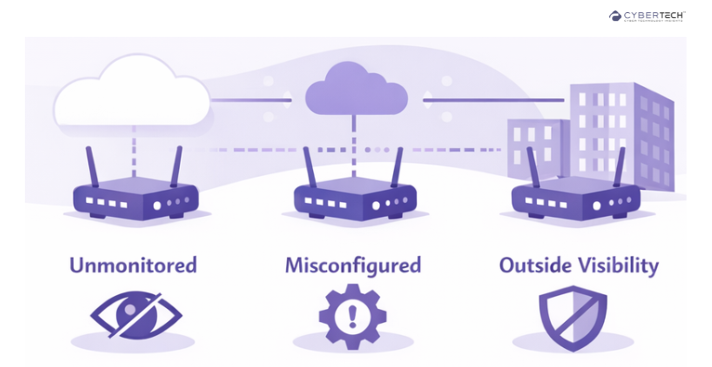
This creates a disconnect.
While policy is evolving to secure what comes next, organizations still lack clarity on what is already inside their networks. That is where the real exposure exists.
The Strategic Blind Spot in Enterprise Security
Routers were never positioned as security-critical assets. They were built for connectivity, not control.
That assumption persists.
Today, in many enterprises:
- Routers are owned by networking teams, not security leadership.
- They operate outside SIEM, XDR, and Zero Trust enforcement layers.
- Firmware and configuration governance are inconsistent.
- Legacy devices remain active without visibility.
This creates a structural misalignment.
Security investments are concentrated where visibility exists. Risk accumulates where it does not.
Identify Your Exposure
Before reading further, consider this:
Do you have a real-time inventory of all routers across your environment?
Are they integrated into your security monitoring stack?
When was the last time they were audited?
If the answer is unclear, your organization likely has a network edge visibility gap.
Why Routers Are Becoming a High-Value Target
Attackers are not just evolving. They are adapting to enterprise blind spots.
Routers provide three strategic advantages:
1. Persistent Access
Routers are always-on infrastructure. Once compromised, they enable long-term, low-noise access.
2. Low Detection Probability
Unlike endpoints, routers often lack deep telemetry integration. Threat activity blends into normal traffic.
3. Weak Governance Cycles
Delayed firmware updates and inconsistent configuration practices create predictable vulnerabilities.
The result is simple.
Attackers are not breaking through. They are slipping in through what is not being watched.
The Deeper Security Implications Behind the FCC Move
Recent regulatory action targeting foreign-made routers reflects rising concern over supply chain exposure and infrastructure trust.
However, this is only part of the equation. Regulation focuses on what enters the environment. Leadership must focus on what already exists within it.
The installed base of routers across enterprises remains under-monitored, under-secured, and under-prioritized.
The risk is already operational.
Decision Framework: Is Your Network Edge Secure?
Use this quick executive-level framework:
| Capability Area | Mature State | Risk Indicator |
| Visibility | Full inventory and monitoring | Unknown devices present |
| Monitoring | Integrated with SIEM/XDR | No centralized logging |
| Patch Management | Scheduled and enforced | Ad-hoc or delayed updates |
| Access Control | Zero Trust enforced | Implicit trust at network edge |
| Ownership | Security and IT alignment | Fragmented accountability |
If you fall into the right column in 2 or more areas, your exposure is significant.
The Hidden Gap in Zero Trust Strategy
Zero Trust has transformed identity and access control.
But its implementation often excludes the network layer.
- Identities are verified.
- Devices are authenticated.
- Applications are secured.
Yet traffic flowing through routers is often implicitly trusted.
This creates a contradiction.
A Zero Trust model built on a partially trusted foundation is inherently incomplete.
Vendor Landscape: How CSPM, NDR, and SASE Compare
To address router-level and network edge risks, leaders often evaluate adjacent solutions.
Here’s how they compare:
| Capability | CSPM | NDR | SASE |
| Focus Area | Cloud misconfigurations | Network traffic analysis | Network and security convergence |
| Router Visibility | Limited | Moderate | High |
| Threat Detection | Cloud-focused | Behavioral detection | Integrated threat prevention |
| Zero Trust Alignment | Partial | Moderate | Strong |
| Deployment Complexity | Low | Medium | High |
| Ideal Use Case | Cloud governance | Threat detection | Full edge security transformation |
Cyber Tech Insight:
No single solution fully addresses router risk in isolation. Leaders must think in terms of integrated network edge security, not point solutions.
CSPM: Cloud Security Posture Management
Cloud-heavy enterprise with strong posture management
Example:
- Microsoft Azure environments use CSPM tools like Defender for Cloud
- Continuous monitoring of misconfigurations
- Strong compliance posture
Cyber Tech Insight:
Even in environments as mature as Azure, CSPM focuses on what’s inside the cloud. It does not validate whether incoming traffic originates from a compromised network edge.
Cloud security assumes trust at the entry point. That assumption is where risk begins.
NDR: Network Detection and Response
Enterprise-grade network visibility
Example:
- Darktrace or Vectra AI deployments in large enterprises.
- AI-driven anomaly detection across internal traffic.
Cyber Tech Insight:
These platforms are highly effective at detecting lateral movement. But they depend entirely on where visibility is deployed.
If a router sits outside monitored flows, detection starts too late.
SASE: Secure Access Service Edge
Secure remote workforce architecture
Example:
- Zscaler or Netskope enables secure access.
- Identity-based access control enforced.
Cyber Tech Insight:
SASE secures who accesses the network and how. But it assumes the underlying network infrastructure is not already compromised.
Access can be verified. Infrastructure often isn’t.
Evaluate Your Security Stack
If your current stack does not provide router-level visibility and control, it may be time to reassess.
Identify where your tools stop. Map where your blind spots begin.
This is where most security gaps emerge.
The Business Risk Leaders Must Quantify
This is not just a technical issue. It is a business risk.
A compromised router can lead to:
- Data interception.
- Lateral movement across systems.
- Long-term undetected access.
- Compliance exposure.
More importantly, it undermines the effectiveness of every other security investment.
Strategic Actions for Security Leaders
To close this gap, leaders must shift from reactive fixes to strategic alignment.
1. Elevate Routers to Security Assets
Treat network devices as part of your core security surface, not background infrastructure.
2. Integrate with Security Operations
Ensure routers feed into centralized monitoring and response workflows.
3. Strengthen Governance
Implement consistent patching, configuration management, and lifecycle policies.
4. Extend Zero Trust to the Edge
Apply identity-aware controls and segmentation at the network level.
5. Align Teams
Break silos between networking and security teams to establish shared accountability.
The Threat Sitting Inside Your Network
You don’t need another security tool to reduce risk; you need to reassess where your current strategy stops. For most organizations, it stops at the router, and that is where exposure begins.
Routers were never treated as security-critical assets. They were assumed to be part of a trusted foundation. However, in today’s threat landscape, that assumption no longer holds.
What sits at the edge of your network is no longer just infrastructure. It is a control point that attackers actively target, persist within, and exploit over time.
Until that layer is brought into visibility, every other security investment operates on incomplete ground.
FAQs
1. Why are routers considered a security risk today?
Routers sit at the network edge and often lack continuous monitoring, timely patching, and integration with security tools. This makes them a persistent and low-visibility entry point for attackers.
2. How does the FCC router ban impact enterprise security strategy?
The FCC action highlights supply chain risks, but it also signals a broader issue. Organizations must reassess the security of existing network infrastructure, not just future device procurement.
3. Are routers included in Zero Trust security models?
In many environments, routers are implicitly trusted and not fully integrated into Zero Trust frameworks. This creates a gap where traffic enters the network without continuous verification.
4. Can existing security tools detect router-based threats?
Tools like NDR and SIEM can detect suspicious activity, but only if router traffic is visible and integrated. Unmonitored routers can allow threats to bypass detection entirely.
5. What should organizations do to secure their network edge?
Security leaders should treat routers as critical assets, enforce patching and configuration controls, integrate them into monitoring systems, and extend Zero Trust principles to the network layer.
To participate in upcoming interviews, please reach out to our CyberTech Media Room at info@intentamplify.com