
Zero Trust security is an architectural approach to cybersecurity that eliminates implicit trust and requires continuous verification for every user, device, application, and data interaction.
Access is not granted based on location or network presence. It is evaluated dynamically, using identity, context, and risk signals at every step.
That’s the formal definition.
In practice, it emerged from a quieter realization. The assumptions on which enterprise security was built on had already stopped holding.
Implementing Zero Trust is relatively straightforward. Operating it at scale, without breaking user experience or internal workflows, is where it becomes difficult.
And that is where the real conversation begins.
Zero Trust Is Where Security Becomes Continuous
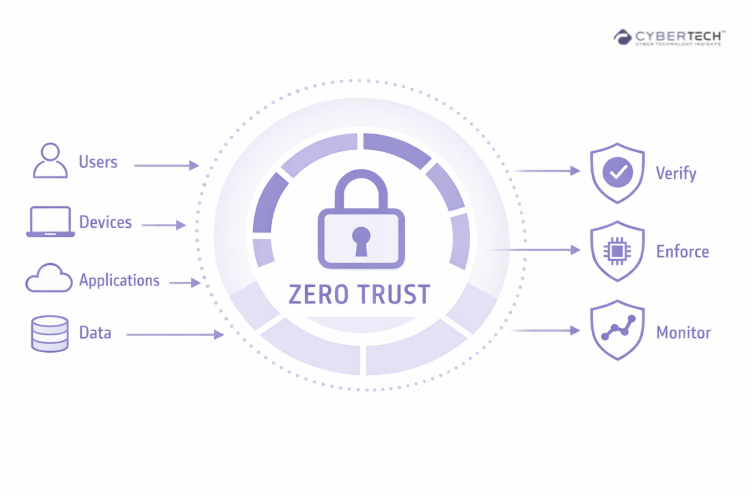
Traditional security models were built around checkpoints. Authenticate once. Enter the network. Move freely unless something triggers suspicion.
Access is no longer a one-time decision. It becomes a continuous process shaped by identity, device posture, behavior, and environmental context. The system doesn’t just ask who you are. It keeps asking if you still have access right now.
This shift matters because the attack surface has changed.
Identity has overtaken the network as the primary entry point for attackers. The majority of modern breaches now involve compromised credentials or identity misuse in some form.
Which means defending the perimeter is no longer enough. In many cases, it’s not even relevant.
So Zero Trust pulls the control plane inward.
Identity becomes central. Access becomes granular. Trust becomes temporary.
That sounds like progress. It is. However, it also introduces new risks for failure.
The Trade-Off That Gets Overlooked
When you remove trust from the network, you don’t eliminate risk. You relocate it.
Identity systems become critical infrastructure. Compromise them, and the model collapses quickly. What used to be lateral movement across networks becomes lateral movement across permissions.
This is where Zero Trust starts to feel less like a solution and more like a rebalancing act.
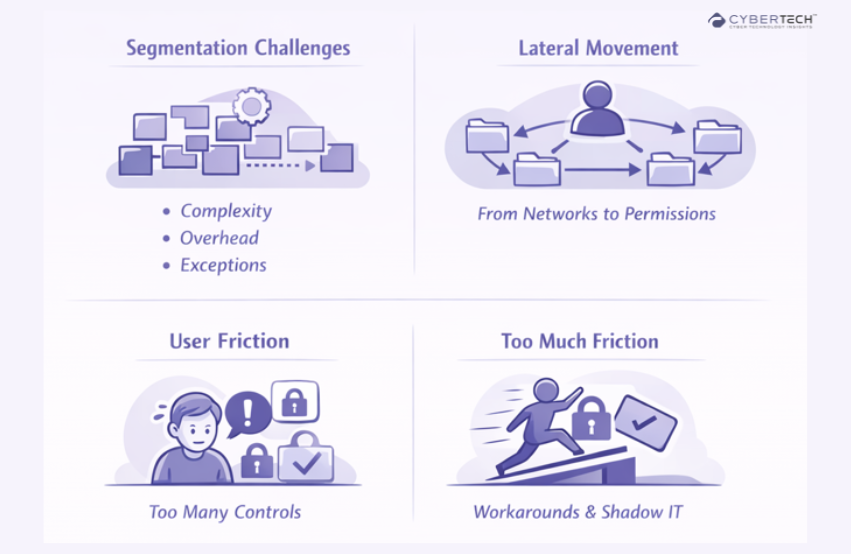
The same applies to segmentation. In theory, it limits attacker movement. In practice, it introduces operational overhead that grows faster than most teams expect.
Policies multiply. Dependencies surface. Exceptions accumulate.
And then there’s user friction.
Every additional control adds resistance. Sometimes subtle, sometimes not. Too much, and users find workarounds. Too little, and the system drifts back toward implicit trust.
There’s no static balance point. It has to be managed continuously.
What the Data Actually Tells Us
Once organizations move beyond early implementation, the benefits become clearer, though not always evenly distributed.
Enterprises report faster threat detection, improved containment, and reduced lateral movement when Zero Trust principles are applied consistently.
Some studies suggest detection and response times improve significantly, while certain categories of incidents drop sharply.
But these gains tend to show up in environments that already have strong visibility and identity hygiene.
In less mature environments, the initial effect can feel like regression. More alerts, more denied access and more operational noise. Zero Trust exposes weaknesses before it resolves them.
Which is why many initiatives stall.
Not because the model doesn’t work, but because the transition phase is harder than expected.
This is the point where enterprises begin consolidating fragmented controls into unified security platforms. Whether through identity-first ecosystems or broader solution hubs like those emerging across vendors such as Palo Alto Networks, the goal becomes less about adding controls and more about aligning them.
“Today, the rise of AI and the explosion of machine identities have made it clear that the future of security must be built on the vision that every identity requires the right level of privilege controls,” shares Nikesh Arora, Chairman and CEO of Palo Alto Networks.
The Maturity Gap Is the Real Story
A large percentage of enterprises claim Zero Trust adoption. Far fewer operate it in a way that aligns with its core principles.
The data reflects a structural gap rather than a maturity curve. While 81% of organizations report Zero Trust implementation, 49% still struggle to manage policies consistently across fragmented, multi-cloud environments.
Basic implementations often focus on MFA and conditional access. Important, but limited.
More advanced environments introduce segmentation, least-privilege access, and workload-level controls. This is where posture begins to shift meaningfully.
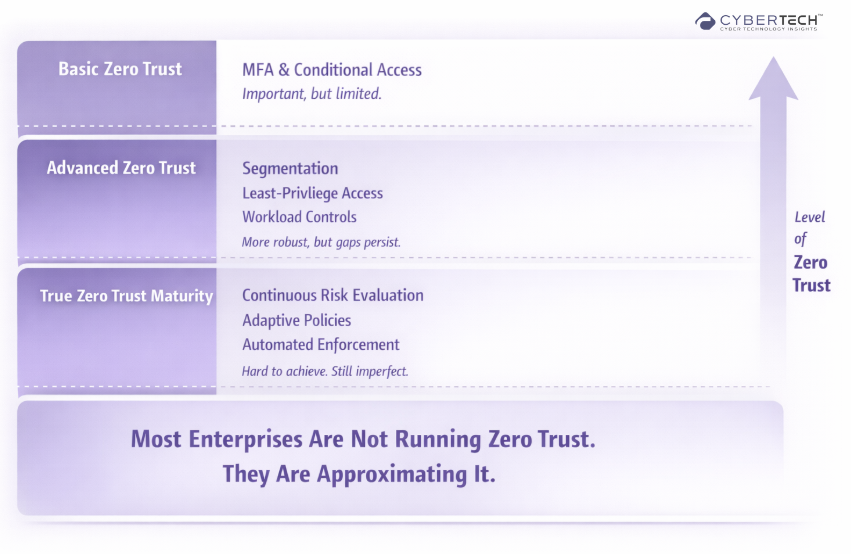
True maturity is harder to reach.
It involves continuous risk evaluation, adaptive policies, and automation that reduces manual intervention without removing accountability.
Even then, gaps remain. In many organizations, least-privilege access is inconsistently enforced, and just-in-time access is applied selectively rather than systematically.
Which raises a blunt but necessary point.
Most enterprises are not running Zero Trust. They are approximating it.
Why Zero Trust Keeps Expanding
The model continues to gain traction for one reason. The environment keeps getting harder to secure.
Hybrid work has dissolved traditional boundaries. SaaS ecosystems have fragmented data ownership. AI systems are introducing new layers of unverified input and output.
Security is no longer about defending a defined space. It’s about governing access across a constantly shifting landscape.
This is pushing Zero Trust beyond identity and network access into data itself.
More organizations are beginning to apply Zero Trust principles at the data layer, driven by the need to control how information is accessed, shared, and modified in real time.
The scope is expanding. So is the complexity.
Implementation Is Where Costs Concentrate
Zero Trust is not bought. It’s built.
Which means the real investment sits in integration, redesign, and operational change.
A large percentage of enterprises claim Zero Trust adoption. Far fewer operate it in a way that aligns with its core principles.
That gap becomes visible when you look at how buyers themselves evaluate vendors across platforms like Gartner Peer Insights, where implementation complexity and fragmented tooling surface consistently in user feedback.
Enterprise implementations often run into hundreds of thousands of dollars, with some estimates averaging around $650,000+ and timelines stretching 7 to 11 months.

That spend isn’t just tooling. It includes:
- Identity consolidation.
- Legacy system integration.
- Policy design and testing.
- Change management across teams.
And this is where many organizations underestimate effort.
Zero Trust exposes architectural inconsistencies that were previously hidden. Fixing those is not optional. It becomes part of the cost.
What Enterprise Buyers Should Be Questioning
By now, most leadership teams have accepted that Zero Trust is necessary.
That’s not where the real decisions are.
The harder questions sit beneath the surface:
Where does implicit trust still exist in the environment?
Which identities have accumulated more access than they should?
How much operational friction is the business willing to absorb?
Is the architecture cohesive, or is it a collection of vendor-aligned tools?
Zero Trust doesn’t fail due to lack of technology.
It fails when organizations underestimate how much internal behavior needs to change.
The Bottom Line
Zero Trust is often perceived as the future of cybersecurity.
It’s in fact a correction to a model that no longer reflects how enterprises actually operate.
It doesn’t simplify security. It makes it more explicit. More continuous. Less forgiving of assumptions.
That’s precisely why it’s becoming essential.
FAQs
1. What does Zero Trust actually change in enterprise security architecture?
Zero Trust shifts control from network boundaries to identity and context. Instead of granting broad access after authentication, it enforces continuous verification across users, devices, and workloads, reducing lateral movement and limiting breach impact.
2. Why do many Zero Trust initiatives fail to deliver expected outcomes?
Most failures stem from partial implementation. Organizations adopt MFA or conditional access but stop short of enforcing least-privilege access, segmentation, and continuous monitoring, leaving underlying trust assumptions intact.
3. How does Zero Trust impact business operations and user experience?
It introduces controlled friction. Stronger verification and access policies can slow workflows if poorly designed, but when implemented well, they balance security with usability through adaptive access and automation.
4. What are the biggest challenges in scaling Zero Trust across large enterprises?
Integration complexity, fragmented security tools, and inconsistent policy enforcement across multi-cloud environments are the primary barriers. Scaling Zero Trust requires architectural alignment, not just additional tools.
5. How should enterprises measure the ROI of Zero Trust security?
ROI is measured indirectly. Through reduced breach impact, faster detection and response, and limited lateral movement. The value lies in minimizing risk exposure rather than generating immediate financial returns.
To share your insights, please write to us at news@intentamplify.com