Black Friday is the Super Bowl of online shopping. Website traffic skyrockets, customers rush to find deals, and revenue hits record highs. At the same time, cyberattacks surge. Demand peaks – and so does risk. Cyberattacks on the retail sector spike by 35-45% during Black Friday week.
So here’s the real question:
Is your eCommerce infrastructure prepared to stay fast, secure, and reliable when millions of shoppers are browsing, comparing, and checking out at once?
If that thought makes you take a deep breath, that’s perfectly normal. Black Friday isn’t just about selling – it’s about staying online, staying secure, and earning trust. U.S. shoppers are projected to spend over $15 billion online within 24 hours of Black Friday 2025. Adobe: U.S. Holiday Shopping Season to Cross $250 Billion Online, Rising 5.3% YoY.
Why Security and Performance Define Black Friday Success
Traffic is good, but uncontrolled traffic is not.
A wave of genuine shoppers can boost sales, but one spike of bad traffic – bots, credential stuffing, or DDoS attacks – can slow or shut down a website.
Even a one-second checkout delay can lead to 60% cart abandonment, according to Baymard Institute. Security isn’t only about keeping threats away; it’s about keeping shoppers engaged, purchasing, and returning. 81% of online shoppers abandon a retailer permanently after a data-related negative experience.
Recommended: Black Friday Sparks 600 Percent Surge in Retail Cyber Scams
Smart Ways to Secure eCommerce Infrastructure for Peak Traffic
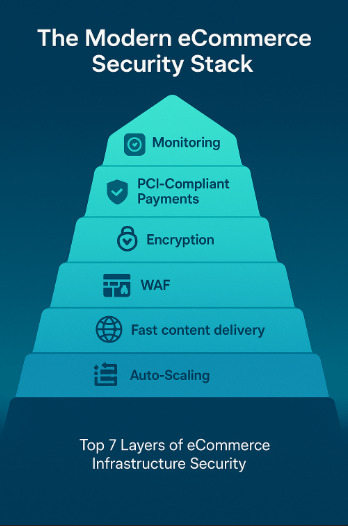
1. Use Auto-Scaling for Real-Time Traffic Surges
Auto-scaling allocates cloud resources based on demand – so if traffic spikes 10X, your infrastructure expands automatically. When traffic drops, costs drop too. It keeps performance stable without manual intervention. Retailers using automated cloud scaling achieved 22% higher revenue during peak sales.
2. Deploy a Web Application Firewall (WAF)
A WAF stops malicious traffic before it reaches your store. It protects against:
- SQL injections
- Cross-site scripting
- Brute-force login attempts
- Bad bots
Industry reports show WAF-enabled sites experience 40% fewer successful breaches. WAF adoption grew 18% in the retail sector in 2024 due to rising web attacks.
3. Add Bot-Mitigation to Protect Inventory and Checkout
Black Friday attracts bots that:
- Grab limited-edition items
- Create fake accounts
- Abuse promo codes
Modern bot-mitigation tools (Cloudflare, HUMAN Security, PerimeterX) analyze behavior, ensuring real shoppers move smoothly while fake traffic gets filtered out.
4. Encrypt Every Touchpoint – Not Just Checkout
Confidentiality builds trust. Encrypt:
- Login forms
- Saved cards
- Loyalty program data
- Personal shopping lists
More than 80% of retail data leaks involve stolen customer credentials, so encryption across the entire user journey matters.
5. Use a CDN to Maximize Speed and Reduce Latency
A CDN distributes website content across global servers. Result:
- Faster load time
- Less strain on the main server
- Fewer abandoned carts
Deloitte reports that a 0.1-second mobile speed boost can increase conversions by up to 8%. CDN usage among the top 1,000 eCommerce websites is 96%.
6. Run Load Tests Before Black Friday
Load testing simulates peak demand, letting you fix bottlenecks before real users arrive. Test:
- Flash deal traffic
- Concurrent checkouts
- Promo code surges
Tools like JMeter and Loader.io make this simple, measurable, and essential.
7. Maintain PCI-Compliant Payment Systems
During Black Friday, fraudulent transactions rise by more than 22% (NRF). Payment systems should include:
- Tokenization
- Secure gateways
- Multi-factor authentication
- End-to-end encryption
Safe checkout = confident repeat buyers.
Key Takeaways
If nothing else sticks, remember this:
- A fast and secure website wins Black Friday
- Performance and security strengthen each other
- Auto-scaling + WAF + bot protection = peak resilience
- PCI-secure payments build loyalty beyond seasonal sales
- A small delay in performance can cost thousands of conversions
A stable, secure platform isn’t just an IT goal – it’s a revenue booster.
Conclusion
Black Friday isn’t about surviving the traffic spike – it’s about leveraging it confidently. With the right mix of performance and security engineering, customers enjoy smooth browsing, fast checkout, and trusted data protection. When shoppers feel safe and satisfied, sales follow naturally.
FAQs
1. Do small e-commerce stores need WAF and bot protection?
Yes. Nearly 46% of retail cyberattacks target small and mid-market retailers, not just big brands.
2. How early should retailers prepare for Black Friday traffic?
Experts recommend starting 8–12 weeks in advance.
3. Is auto-scaling enough to prevent downtime?
Auto-scaling improves performance but must pair with WAF and CDN for full protection.
4. Does encryption slow down websites?
Not with modern TLS. It protects shoppers while keeping speed intact.
5. Is load testing required every year?
Yes. Each year brings new traffic patterns, promo types, and user behaviors.
Don’t let cyber attacks catch you off guard – discover expert analysis and real-world CyberTech strategies at CyberTechnology Insights.
To participate in upcoming interviews, please reach out to our CyberTech Media Room at info@intentamplify.com.