It’s not every day that news makes tech professionals sit up a little straighter. But Microsoft’s recent $10 billion investment to build a next-generation AI hub in Sines, Portugal, is one of those moments. It signals much more than expanding cloud real estate. It marks a major shift in how and where enterprise-grade AI will run in the future.
Worldwide AI spending forecast to hit $1.5T in 2025, as per Gartner.
If you’re a tech enthusiast, a business decision-maker, or someone who lives and breathes cloud and cybersecurity, this development touches your world more than you may realize.
Why Portugal – And Why Now?
Sines might not have been the first name on your mental map of global tech hubs. Yet the choice is far from random. The Atlantic coastal city sits at a prime point for subsea cable routes linking Europe, Africa, and the Americas. That makes it a crossroads for global connectivity – exactly what AI workloads need.
Energy also plays a part. Modern AI data centres are hungry for power. Sines offers access to greener energy sources and favourable climate conditions for cooling – two advantages that translate into more sustainable AI operations. Global demand for AI-ready data-centre capacity rising at ~33% per year through 2030 – McKinsey.
It’s a reminder that AI isn’t only about models and data. It’s also about location, power, networking, and heat – very real-world things.
What Makes This Investment Stand Out?
Microsoft’s expansion in Portugal wouldn’t be making headlines if it were “just another data centre.” The scale is what sets it apart.
The hub will support thousands of high-performance GPUs designed for large-scale AI training and inference. Think of the models powering copilots, autonomous analytics, predictive forecasting, and real-time personalization – this hub is being built for those kinds of workloads.
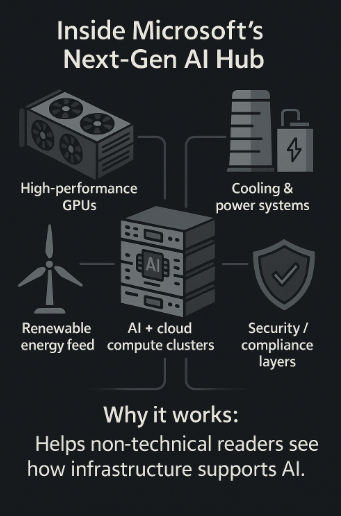
A few facts highlight the magnitude:
- It ranks among Microsoft’s largest infrastructure investments in Europe to date.
- It’s expected to accelerate AI compute capacity across the region, reducing latency for enterprises.
- It reinforces Europe’s role as a strategic player in the AI infrastructure race, not just a consumer of it. End-user spending on AI-optimized IaaS expected to hit $37.5B in 2026.
This isn’t hype. It’s an engineering and capital meeting strategy.
What This Signals To Professionals
Here’s the bigger message behind the announcement:
AI success is now tied directly to physical infrastructure.
For the last few years, the AI conversation has focused mainly on software-model architectures, use cases, regulations, and risks. Now the pendulum swings back toward the foundations: compute supply, energy, sovereignty, and capacity planning.
If you’re leading a digital or AI transformation, this is a wake-up call:
- Model ambition should match computational reality.
- Vendor selection must include energy, hardware availability, and region.
- Governance frameworks must adapt to multi-geography deployment models.
And yes – understanding where your AI actually runs will increasingly matter to compliance teams, CISOs, and CIOs.
What Does It Mean For Businesses?
You don’t need to be running multimillion-dollar AI workloads to feel the ripple effects. Here’s what to expect:
Better performance for AI and cloud services in Europe
Lower latency and higher compute availability can boost analytics, automation, and generative-AI tools for enterprise users.
More transparency demands on vendors
Enterprises are likely to start asking sharper questions:
- Where is my data processed?
- What hardware runs my models?
- How sustainable is the operation?
A new wave of AI-focused talent demand
Not only data scientists. Infrastructure engineers, GPU-cluster architects, and cloud-to-edge specialists will be increasingly valued.
Faster enterprise adoption of AI workflows
More compute supply often unlocks more AI use cases – because cost and speed become less of a barrier. Europe’s data-centre power demand expected to reach ~35 GW by 2030 – McKinsey.
In other words, AI will feel less experimental and more operational.
A Quick Thought Before We Wrap Up
If AI were a skyscraper, models would be the glimmering glass on top – but data centres, power, connectivity, and cooling are the steel beams holding everything up. Microsoft’s investment in Portugal simply reinforces that we’ve entered the “build for scale” era of AI.
And for anyone working in tech, the message is clear: now is the time to align strategies, architectures, and teams with the new infrastructure reality.
FAQs
1. What exactly is being built in Portugal?
A large-scale AI data-centre hub engineered for high-performance GPU workloads and cloud-scale AI services.
2. Why did Microsoft choose Sines?
Because of its subsea cable access, energy advantages, and strategic location connecting multiple continents.
3. Will this hub reduce AI latency for European businesses?
Yes. Increased regional compute capacity generally improves speed and performance for AI-driven applications.
4. Does this investment relate to responsible AI?
Yes. Sustainability, energy efficiency, and governance are core goals of the hub’s design.
5. How should organizations respond to this shift?
Review vendor infrastructure, align AI governance to multi-region deployment, and invest in infrastructure-aware skill sets.
Don’t let cyber attacks catch you off guard – discover expert analysis and real-world CyberTech strategies at CyberTechnology Insights.
To participate in upcoming interviews, please reach out to our CyberTech Media Room at info@intentamplify.com.