In the ever-changing landscape of cloud computing, managing network infrastructure while maintaining strong security is becoming increasingly difficult for organizations. Network as a Service (NaaS) is an innovative service model technology that simplifies network management and administration by providing on-demand access to networking resources through a subscription model. NaaS eliminates the need for substantial on-premise infrastructure by enabling organizations to subscribe to and use networking services online. This innovative solution allows organizations to enjoy taking advantage of cutting-edge networking capabilities without worrying about procuring and maintaining the actual hardware.
NaaS leverages cloud-based technologies to offer a scalable and adaptable solution that can be used to meet the rapidly evolving requirements of organizations. When network resources are provisioned, configured, and managed dynamically, organizations can efficiently scale up or down in response to demand. This approach improves agility while removing the need for physical hardware maintenance, allowing organizations to concentrate on their core strengths.
Moreover, NaaS encourages cost-effectiveness by enabling organizations to employ a pay-per-use invoicing model to only pay for the services they use. As organizations increasingly embrace digital transformation, NaaS stands out as a critical component in achieving seamless connectivity and robust network management in today’s interconnected world.
Recommended: Cybersecurity Simplified: What is Cloud Infrastructure Security?
What is Network as a Service (NaaS)?
NaaS is an Internet-based cloud service model that allows organizations on-demand access to networking resources. Instead of investing in network infrastructure, organizations can obtain networking services and capabilities from a cloud provider, which removes the hassle of managing networks and maintaining hardware. This strategy allows for quick adaptability to changing needs without the hassle of maintaining physical infrastructure because of its substantial cost savings, scalability, and operational flexibility.
Key Elements of Network as a Service (NaaS)
NaaS allows organizations to access network infrastructure through flexible subscription models, covering operating expenses that include hardware, management tools, software, licensing, and lifecycle services. NaaS includes several essential elements that help organizations implement effective and adaptable networking solutions.
Here are the key elements of NaaS:
1. Connectivity Services
NaaS offers multiple connectivity choices, such as broadband, mobile connectivity such as 4G and 5G, wireless networking such as Wi-Fi, and wired access. The multiple choices ensure that devices can effectively connect and interact both inside the organization and across the internet.
2. Network Hardware
Traditional NaaS solutions can include physical hardware, such as switches and routers, while many modern versions use virtualization to reduce the amount of actual hardware. As a result, organizations can now use virtualized network functions.
3. Virtual Network Functions (VNF)
VNFs are applications that run on software and handle crucial network tasks, including load balancing, firewalling, and routing. This virtualization reduces dependence on physical infrastructure while increasing flexibility.
Recommended: Cyber Threat Intelligence: How to Predict and Prevent Cyberattacks?
4. Software-Defined Networking (SDN)
SDN technology allows for centralized network control, enabling dynamic configuration and management of network resources. This programmability allows for changes to be made on-demand to meet evolving organizational needs.
5. Security Services
Integrated security features such as intrusion detection systems (IDS), intrusion prevention systems (IPS), virtual private networks (VPNs), and firewalls are all part of NaaS. These services aid in maintaining data integrity and shielding the network from dangers.
6. Cloud Services
As a cloud-based model, NaaS utilizes cloud computing to coordinate and automate network usage by several users. Data storage, backup services, and other cloud apps that improve network performance are included in this.
7. Self-Service Portal
On-demand network service provisioning is made possible via an intuitive user interface. Users may control use, see service levels, and scale services up or down according to their requirements.
8. Management and Maintenance
The NaaS provider usually manages the network infrastructure’s ongoing administration. While customers handle their setups, this also includes system upgrades, troubleshooting, and guaranteeing adherence to security regulations.
9. Pay-Per-Use Billing
Pay-per-use is a prevalent model used by NaaS, in which organizations are billed according to the actual amount of networking resources used. Cost efficiency is increased by this method, which allows organizations to only pay for what they utilize.
10. Scalability and Flexibility
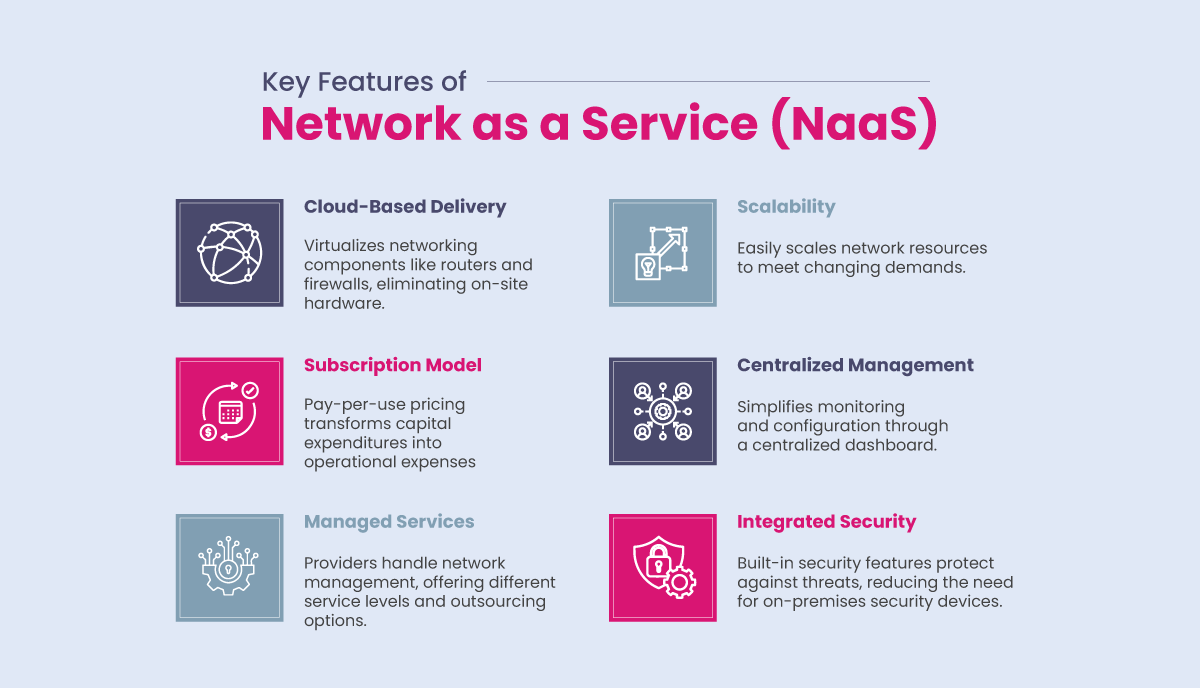
Organizations can readily adapt to growth or seasonal fluctuations by quickly scaling their network resources in response to changing demands, all while spending little on initial infrastructure.
Collectively, these elements make NaaS an attractive proposition for organizations seeking to optimize networking operations, reduce expenses, and simplify networking infrastructure. This integrated solution provides productive, adaptable, and economically viable networking capabilities, effectively addressing the dynamic requirements of contemporary enterprises.
Recommended: Top AI Security Tools for Financial Services Industry
How Does NaaS Work?
NaaS operates through a cloud-based platform where customers subscribe to services. It functions by removing the multifaceted nature of conventional networking through abstraction. It provides adaptable network resource access without requiring physical infrastructure.
Here’s how NaaS works:
- Cloud-Based Infrastructure: With the use of a cloud platform run by service providers, NaaS enables organizations to access networking services through online portals or APIs (Application Programming Interfaces).
- Subscription Model: Organizations can subscribe to NaaS offerings as per their requirements. This subscription includes various services such as bandwidth on demand, VPNs, and security features. This model often transforms capital expenditures into operational expenses.
- Managed Services: Everything pertaining to network management, including deployment and maintenance, is managed by the provider.
- Rented Hardware: Although they are in charge of installation and operation, customers rent hardware that belongs to the provider.
- Centralized Management: Simplifying operations and troubleshooting, users can monitor and manage their network resources from a single dashboard.
Benefits of NaaS
NaaS offers a revolutionary method for organizations looking to improve network administration. It provides a number of benefits to organizations looking to improve their network infrastructure:
1. Cost Efficiency
NaaS significantly reduces the requirement for large upfront hardware and infrastructure investments. The subscription model significantly removes the financial burden of upgrading and maintaining physical equipment, as now these expenses are covered by the NaaS provider.
2. Scalability
The unmatched scalability provided by NaaS allows organizations to adjust their network resources in response to changing demands in real time. Depending on their existing requirements, organizations can easily scale their network resources up or down to accommodate expansion or operational changes.
3. Focus on Core Competencies
Organizations can focus on their core business operations instead of the complexities of networking by outsourcing network management to a NaaS provider. In addition to increasing productivity, this shift allows the internal IT team to focus on strategic projects rather than the intricate details of network maintenance.
Recommended: Cybersecurity Simplified: LLMjacking Attacks
4. Enhanced Security
Many NaaS providers offer integrated security services such as firewalls and encryption, which help reduce the need for on-premises security appliances and ensure robust protection against threats. This allows organizations to establish a robust cybersecurity mechanism. Additionally, providers often update security measures proactively to address emerging vulnerabilities, thereby maintaining a secure network environment.
5. Rapid Deployment and Simplified Management
NaaS significantly reduces provisioning times by facilitating the rapid deployment of networking services. Organizations can remain flexible in a business environment that is changing rapidly by implementing new features or making adjustments. The provider streamlines operations and allows internal personnel to focus on other important duties by managing every part of the network.
6. Access to Cutting-Edge Technology
Organizations gain constant access to the latest networking technologies with NaaS, eliminating the need for laborious manual upgrades. This ensures that organizations can employ new tools and skills as they become available and maintain competitiveness.
7. Predictable Costs and Budgeting
Finance teams can effortlessly foresee spending because of the predictable budgeting made possible by the NaaS subscription model. Organizations can avoid overprovisioning and closely align expenses with actual consumption by only paying for the resources they utilize.
8. Proactive Support and Maintenance
NaaS providers usually provide continuous support and monitoring services that find and fix problems before they affect business operations. Through proactive management, downtime is reduced and network performance is maintained at its best, enabling organizations to run more effectively.
In summary, by taking advantage of these benefits, organizations can put themselves in a better position to prosper in an increasingly digital environment.
Recommended: Top 10 Emerging Cybersecurity Technologies for 2025
Conclusion
NaaS signifies a radical change in how organizations handle their networking requirements. Organizations can benefit from increased flexibility, lower expenses, and enhanced operational efficiency while preserving high performance and security standards by utilizing cloud technology. NaaS is probably going to grow in popularity as the digital transformation progresses and more businesses look to expand their network capabilities without having to deal with the hassles of managing traditional infrastructure. In addition to streamlining network administration, NaaS improves corporate agility, security, and cost-effectiveness. All things considered, NaaS streamlines network administration by enabling organizations to concentrate on their core competencies while outsourcing the intricate network architecture.
To share your insights, please write to us at news@intentamplify.com